

When buyers talk about what a multi-family building is worth, they are really talking about income. Not the asking price. Not what another building sold for. Income. That income is called net

Dated: September 15 2026
Views: 64
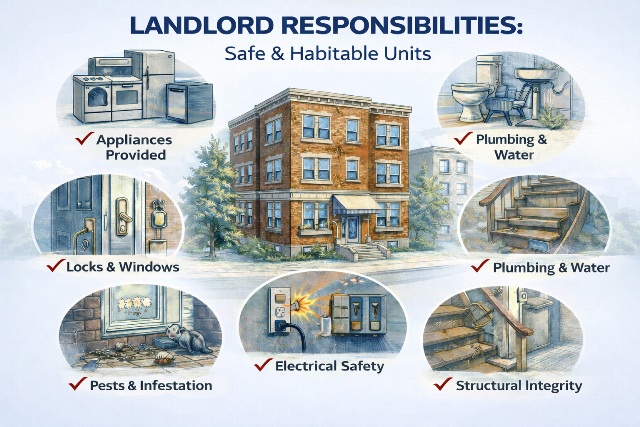
In Chicago and Cook County, landlords are not required to fix everything a tenant doesn’t like — but they are required to keep the unit safe, habitable, and in working order. Most confusion around repairs comes from not understanding where the line is between habitability and cosmetic or convenience issues.
The law doesn’t expect perfection. It expects basic living conditions.
At a high level, landlords are responsible for repairs that affect health, safety, and essential services. If something makes the unit unsafe, unsanitary, or unlivable, it’s generally the landlord’s responsibility to fix it — regardless of what the lease says.
Heat is one of the clearest examples. If the heating system isn’t working during the heating season, that’s not optional and not negotiable. The same is true for running water, hot water, electricity, and properly functioning plumbing. A tenant doesn’t have to live with no heat, no water, or raw sewage because a lease says “as-is.”
Structural integrity also matters. Issues like roof leaks, ceiling collapse risks, broken stairs, unstable railings, or unsafe floors fall squarely on the landlord. These aren’t cosmetic concerns — they’re safety issues.
Windows and doors are another common area of confusion. Landlords are generally responsible for making sure exterior doors and windows close properly, lock, and protect the unit from the elements. A broken lock or a window that won’t close isn’t just an inconvenience — it’s a security issue.
Appliances are slightly different. If an appliance is provided as part of the rental — such as a stove, refrigerator, or dishwasher — the landlord is typically responsible for keeping it in working order. If the tenant damages it through misuse, that’s another discussion. But normal wear and tear failures are not the tenant’s responsibility.
Electrical issues that pose a safety risk also fall on the landlord. Flickering lights due to faulty wiring, outlets that don’t work, exposed wiring, or repeated breaker failures aren’t things a tenant is expected to live with or repair themselves.
Pest issues are another area where landlords often get caught off guard. In Chicago and Cook County, infestations that affect habitability — such as rodents or insects — are usually the landlord’s responsibility to address, even if the tenant’s behavior may have contributed. This doesn’t mean tenants have no responsibility, but landlords can’t simply ignore an infestation once it’s reported.
Where landlords are not generally required to act is on purely cosmetic issues. Peeling paint (that is not lead-related), worn flooring, outdated cabinets, or minor cracks that don’t affect safety usually don’t trigger legal repair obligations. Tenants may not like them, but dislike alone doesn’t create a legal duty.
Another common misunderstanding involves tenant-caused damage. Landlords are not required to repair damage caused by a tenant’s misuse or neglect without addressing responsibility. You may still need to fix the issue to maintain habitability, but that doesn’t mean the tenant isn’t financially responsible for the damage.
Timing also matters. Chicago and Cook County expect landlords to respond to repair requests within a reasonable time, which depends on the seriousness of the issue. No heat in winter is urgent. A dripping faucet is less so. Ignoring serious repair requests or dragging them out can give tenants certain legal remedies, which is why documenting response and repair efforts is important.
Finally, lease language cannot waive habitability obligations. A lease can assign certain minor maintenance tasks to tenants, but it cannot shift core health and safety responsibilities away from the landlord. If a lease clause conflicts with habitability requirements, the law wins.
Most landlord-tenant repair disputes aren’t about bad intentions. They’re about misunderstandings — what’s required, what’s optional, and who is responsible when something breaks. Knowing the difference helps owners protect themselves and manage expectations.
If you want to talk through a specific repair situation or review how your lease addresses maintenance and responsibility under Chicago and Cook County rules, call or email me and I’d be happy to walk through it with you.
Get these articles delivered free to your inbox:
When buyers talk about what a multi-family building is worth, they are really talking about income. Not the asking price. Not what another building sold for. Income. That income is called net
In Chicago and Cook County, landlords are not required to fix everything a tenant doesn’t like — but they are required to keep the unit safe, habitable, and in working order. Most
Mixed-use buildings can be great investments, but they also get discounted quickly when leases aren’t structured properly. Buyers look very closely at mixed-use leases because one poorly
For many long-time apartment owners, retirement doesn’t start with the question “How much is my building worth?” It starts with a different one: Do I really want to keep doing this
 Midwest Real Estate Data (MRED) All information deemed reliable but not guaranteed. All properties are subject to prior sale, change or withdrawal. Neither listing broker(s) or information provider(s) shall be responsible for any typographical errors, misinformation, misprints and shall be held totally harmless. Listing(s) information is provided for consumer's personal, non-commercial use and may not be used for any purpose other than to identify prospective properties consumers may be interested in purchasing. The data relating to real estate for sale on this website comes in part from the Internet Data Exchange program of the Multiple Listing Service. Real estate listings held by brokerage firms other than Weichert, Realtors® - All Pro - Park Ridge may be marked with the Internet Data Exchange logo and detailed information about those properties will include the name of the listing broker(s) when required by the MLS. Copyright ©2026 All rights reserved.Based on information submitted to the MLS GRID as of September 22, 2026 9:51 PM UTC All data is obtained from various sources and may not have been verified by broker or MLS GRID. Supplied Open House Information is subject to change without notice.
Data is updated as of September 22, 2026 9:51 PM UTC
Midwest Real Estate Data (MRED) All information deemed reliable but not guaranteed. All properties are subject to prior sale, change or withdrawal. Neither listing broker(s) or information provider(s) shall be responsible for any typographical errors, misinformation, misprints and shall be held totally harmless. Listing(s) information is provided for consumer's personal, non-commercial use and may not be used for any purpose other than to identify prospective properties consumers may be interested in purchasing. The data relating to real estate for sale on this website comes in part from the Internet Data Exchange program of the Multiple Listing Service. Real estate listings held by brokerage firms other than Weichert, Realtors® - All Pro - Park Ridge may be marked with the Internet Data Exchange logo and detailed information about those properties will include the name of the listing broker(s) when required by the MLS. Copyright ©2026 All rights reserved.Based on information submitted to the MLS GRID as of September 22, 2026 9:51 PM UTC All data is obtained from various sources and may not have been verified by broker or MLS GRID. Supplied Open House Information is subject to change without notice.
Data is updated as of September 22, 2026 9:51 PM UTC
33. Required DMCA Notice
The Digital Millennium Copyright Act of 1998, 17 U.S.C. §512, the DMCA, provides recourse for copyright owners who believe that material appearing on the Internet infringes their rights under U.S. copyright law. If you believe in good faith that any content or material made available in connection with our website or services infringes your copyright, you (or your agent) may send us a notice requesting that the content or material be removed, or access to it blocked. Notices must be sent in writing by email to DMCAnotice@MLSGrid.com. The DMCA requires that your notice of alleged copyright infringement include the following information: (1) description of the copyrighted work that is the subject of claimed infringement; (2) description of the alleged infringing content and information sufficient to permit us to locate the content; (3) contact information for you, including your address, telephone number and email address; (4) a statement by you that you have a good faith belief that the content in the manner complained of is not authorized by the copyright owner, or its agent, or by the operation of any law; (5) a statement by you, signed under penalty of perjury, that the information in the notification is accurate and that you have the authority to enforce the copyrights that are claimed to be infringed; and (6) a physical or electronic signature of the copyright owner or a person authorized to act on the copyright owners behalf. Failure to include all of the above information may result in the delay of the processing of your complaint.
Copyright © 2026 Midwest Real Estate Data LLC. Data is updated as of September 22, 2026 9:51 PM UTC