

Mixed-use buildings can be great investments, but they also get discounted quickly when leases aren’t structured properly. Buyers look very closely at mixed-use leases because one poorly

Dated: July 11 2026
Views: 28
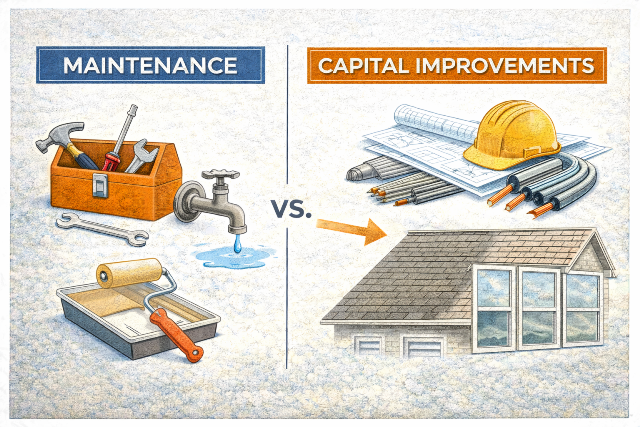
This question usually comes up when an owner is staring at a big bill and wondering, “Is this just upkeep, or did I actually improve the building?” The distinction matters for taxes, valuation, financing, and even buyer perception. In Chicago and Cook County, the legal definitions don’t change the concept — but the practical consequences absolutely do.
At a basic level, maintenance keeps the property operating, while capital improvements extend the life of the building or materially increase its value. The confusion happens because both can involve contractors, permits, and real dollars, but they are treated very differently.
Maintenance is about preservation. These are the routine or recurring repairs that keep systems working the way they were intended to work. Fixing a leaking faucet, repairing a section of drywall, replacing a broken appliance with a comparable one, patching a roof leak, snaking a drain, or repainting a unit between tenants all fall into this category. These repairs don’t fundamentally change the property. They just prevent it from getting worse.
Capital improvements, on the other hand, change the building in a meaningful way. They either extend the useful life of a major component or improve the property beyond its prior condition. Replacing an entire roof instead of patching it, installing new boilers, upgrading electrical service, replacing plumbing stacks, installing new windows throughout the building, adding central air, or fully renovating kitchens and baths are common examples. These aren’t quick fixes — they’re investments.
One of the easiest ways owners tell the difference in real life is this: If I didn’t do this, would the building eventually fail or fall behind the market? If the answer is yes, you’re usually looking at a capital improvement. Maintenance keeps you compliant and operational. Capital work moves the building forward.
Another way to think about it is lifespan. Maintenance items tend to wear out quickly and recur regularly. Capital improvements last many years and don’t happen often. You don’t replace a roof every year. You don’t upgrade electrical service every turnover. That’s why capital items are treated differently for accounting and valuation.
This distinction becomes especially important when you’re selling or refinancing. Buyers don’t give you extra credit for routine maintenance — they expect it. But they do pay attention to capital improvements because those reduce future risk and future expenses. A building with a new roof, updated mechanicals, and modern systems is easier to underwrite and often commands a higher price, even if current rents are the same.
For tax purposes, maintenance is typically expensed in the year it occurs, while capital improvements are depreciated over time. That doesn’t mean maintenance is less important — it just means it’s treated as a cost of doing business rather than an asset upgrade. Owners sometimes try to stretch definitions to expense big-ticket items immediately, but that’s where coordination with a tax professional matters.
Chicago and Cook County enforcement doesn’t usually care how you label the work — inspectors care whether the building is safe and code-compliant. But lenders, buyers, and accountants absolutely care how the work is categorized. Mixing the two can distort your financials and make a property look weaker or riskier than it actually is.
In practice, well-run buildings need both. Maintenance keeps tenants happy and violations away. Capital improvements protect long-term value and marketability. Problems arise when owners confuse the two — either by deferring capital work and calling it “maintenance,” or by expecting maintenance spending to increase value the way capital improvements do.
If you’re planning major work and want to understand how buyers, lenders, or appraisers are likely to view it, call or email me and I’d be happy to talk it through with you.
Get these articles delivered free to your inbox:
Mixed-use buildings can be great investments, but they also get discounted quickly when leases aren’t structured properly. Buyers look very closely at mixed-use leases because one poorly
For many long-time apartment owners, retirement doesn’t start with the question “How much is my building worth?” It starts with a different one: Do I really want to keep doing this
When buyers or lenders talk about an environmental study, they’re usually referring to a process that can unfold in up to three phases. Not every property goes through all three. In fact, most
Security cameras have quietly become one of the more practical upgrades a property owner can make. They’re no longer just about recording incidents after the fact. When used correctly, they
 Midwest Real Estate Data (MRED) All information deemed reliable but not guaranteed. All properties are subject to prior sale, change or withdrawal. Neither listing broker(s) or information provider(s) shall be responsible for any typographical errors, misinformation, misprints and shall be held totally harmless. Listing(s) information is provided for consumer's personal, non-commercial use and may not be used for any purpose other than to identify prospective properties consumers may be interested in purchasing. The data relating to real estate for sale on this website comes in part from the Internet Data Exchange program of the Multiple Listing Service. Real estate listings held by brokerage firms other than Weichert, Realtors® - All Pro - Park Ridge may be marked with the Internet Data Exchange logo and detailed information about those properties will include the name of the listing broker(s) when required by the MLS. Copyright ©2026 All rights reserved.Based on information submitted to the MLS GRID as of September 12, 2026 8:30 PM UTC All data is obtained from various sources and may not have been verified by broker or MLS GRID. Supplied Open House Information is subject to change without notice.
Data is updated as of September 12, 2026 8:30 PM UTC
Midwest Real Estate Data (MRED) All information deemed reliable but not guaranteed. All properties are subject to prior sale, change or withdrawal. Neither listing broker(s) or information provider(s) shall be responsible for any typographical errors, misinformation, misprints and shall be held totally harmless. Listing(s) information is provided for consumer's personal, non-commercial use and may not be used for any purpose other than to identify prospective properties consumers may be interested in purchasing. The data relating to real estate for sale on this website comes in part from the Internet Data Exchange program of the Multiple Listing Service. Real estate listings held by brokerage firms other than Weichert, Realtors® - All Pro - Park Ridge may be marked with the Internet Data Exchange logo and detailed information about those properties will include the name of the listing broker(s) when required by the MLS. Copyright ©2026 All rights reserved.Based on information submitted to the MLS GRID as of September 12, 2026 8:30 PM UTC All data is obtained from various sources and may not have been verified by broker or MLS GRID. Supplied Open House Information is subject to change without notice.
Data is updated as of September 12, 2026 8:30 PM UTC
33. Required DMCA Notice
The Digital Millennium Copyright Act of 1998, 17 U.S.C. §512, the DMCA, provides recourse for copyright owners who believe that material appearing on the Internet infringes their rights under U.S. copyright law. If you believe in good faith that any content or material made available in connection with our website or services infringes your copyright, you (or your agent) may send us a notice requesting that the content or material be removed, or access to it blocked. Notices must be sent in writing by email to DMCAnotice@MLSGrid.com. The DMCA requires that your notice of alleged copyright infringement include the following information: (1) description of the copyrighted work that is the subject of claimed infringement; (2) description of the alleged infringing content and information sufficient to permit us to locate the content; (3) contact information for you, including your address, telephone number and email address; (4) a statement by you that you have a good faith belief that the content in the manner complained of is not authorized by the copyright owner, or its agent, or by the operation of any law; (5) a statement by you, signed under penalty of perjury, that the information in the notification is accurate and that you have the authority to enforce the copyrights that are claimed to be infringed; and (6) a physical or electronic signature of the copyright owner or a person authorized to act on the copyright owners behalf. Failure to include all of the above information may result in the delay of the processing of your complaint.
Copyright © 2026 Midwest Real Estate Data LLC. Data is updated as of September 12, 2026 8:30 PM UTC