

Mixed-use buildings can be great investments, but they also get discounted quickly when leases aren’t structured properly. Buyers look very closely at mixed-use leases because one poorly

Dated: June 11 2026
Views: 34
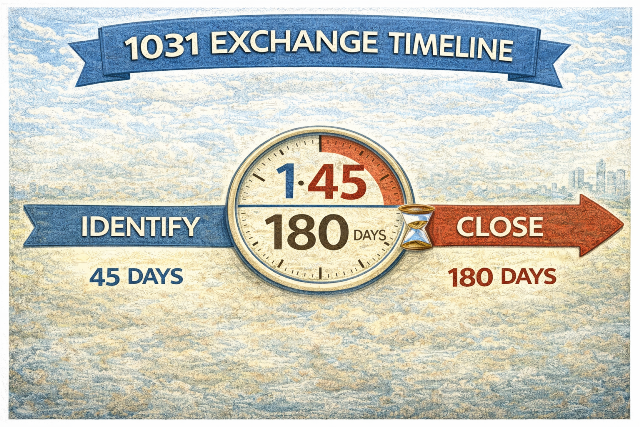
A 1031 exchange allows a real estate owner to sell an investment property and reinvest the proceeds into another qualifying property while deferring capital gains taxes. What makes the process challenging isn’t the concept — it’s the strict timeline. Once the first property closes, the clock starts, and it does not stop.
There are two critical deadlines you must meet: the 45-day identification period and the 180-day exchange period.
The timeline begins the day your original property closes. This property is referred to as the relinquished property.
At closing, the sale proceeds cannot go to you. They must be transferred directly to a qualified intermediary (QI). If you take possession of the funds — even briefly — the exchange is disqualified.
You have 45 calendar days from the closing date to identify potential replacement properties in writing. This is not a suggestion — it’s a hard deadline enforced by the IRS. Weekends and holidays count. Day 45 is day 45, no exceptions.
During this period:
You must identify replacement property (or properties) in writing
The identification must be delivered to your qualified intermediary
The identification must clearly describe the property (address or legal description)
Most investors follow one of these identification rules:
Three-Property Rule: Identify up to three potential properties, regardless of value
200% Rule: Identify more than three properties as long as the total value does not exceed 200% of the sold property’s value
You do not have to close on all identified properties — but you must close on one or more of the properties you identified. Missing the 45-day deadline ends the exchange.
You have 180 calendar days from the sale of the original property to close on the replacement property. This period runs concurrently with the 45-day identification period — it does not start afterward. In other words, the entire exchange must be completed within 180 days of the original closing.
By Day 180:
You must have closed on the replacement property
All exchange funds must be applied
Title must transfer
If you identified multiple properties, you can acquire one or more, as long as they meet the exchange requirements and close within the deadline. There are no extensions unless the IRS declares a federally recognized disaster relief period.
A few timing rules regularly trip people up:
Calendar days, not business days, are used
The deadlines cannot be extended by contract delays
Financing issues do not pause the clock
Seller delays on the replacement property do not pause the clock
This is why many exchangers start looking for replacement options before selling their property.
The 1031 exchange timeline is rigid by design. The IRS allows tax deferral only if the investor keeps momentum and stays invested in real estate. Miss either deadline — the 45-day identification or the 180-day closing — and the exchange fails. When that happens, the sale becomes fully taxable, including capital gains and depreciation recapture.
A 1031 exchange isn’t complicated, but it is time-sensitive. Once your property closes, the clock controls everything. Planning ahead, lining up replacement options early, and working with a qualified intermediary are essential to staying on track.
Before starting an exchange, it’s wise to consult a qualified tax professional. I can also help explain how the real estate side of the timeline works, what buyers typically do to stay ahead of deadlines, and how to avoid common timing mistakes before you commit to a sale.
Get these articles delivered free to your inbox:
Mixed-use buildings can be great investments, but they also get discounted quickly when leases aren’t structured properly. Buyers look very closely at mixed-use leases because one poorly
For many long-time apartment owners, retirement doesn’t start with the question “How much is my building worth?” It starts with a different one: Do I really want to keep doing this
When buyers or lenders talk about an environmental study, they’re usually referring to a process that can unfold in up to three phases. Not every property goes through all three. In fact, most
Security cameras have quietly become one of the more practical upgrades a property owner can make. They’re no longer just about recording incidents after the fact. When used correctly, they
 Midwest Real Estate Data (MRED) All information deemed reliable but not guaranteed. All properties are subject to prior sale, change or withdrawal. Neither listing broker(s) or information provider(s) shall be responsible for any typographical errors, misinformation, misprints and shall be held totally harmless. Listing(s) information is provided for consumer's personal, non-commercial use and may not be used for any purpose other than to identify prospective properties consumers may be interested in purchasing. The data relating to real estate for sale on this website comes in part from the Internet Data Exchange program of the Multiple Listing Service. Real estate listings held by brokerage firms other than Weichert, Realtors® - All Pro - Park Ridge may be marked with the Internet Data Exchange logo and detailed information about those properties will include the name of the listing broker(s) when required by the MLS. Copyright ©2026 All rights reserved.Based on information submitted to the MLS GRID as of September 12, 2026 8:30 PM UTC All data is obtained from various sources and may not have been verified by broker or MLS GRID. Supplied Open House Information is subject to change without notice.
Data is updated as of September 12, 2026 8:30 PM UTC
Midwest Real Estate Data (MRED) All information deemed reliable but not guaranteed. All properties are subject to prior sale, change or withdrawal. Neither listing broker(s) or information provider(s) shall be responsible for any typographical errors, misinformation, misprints and shall be held totally harmless. Listing(s) information is provided for consumer's personal, non-commercial use and may not be used for any purpose other than to identify prospective properties consumers may be interested in purchasing. The data relating to real estate for sale on this website comes in part from the Internet Data Exchange program of the Multiple Listing Service. Real estate listings held by brokerage firms other than Weichert, Realtors® - All Pro - Park Ridge may be marked with the Internet Data Exchange logo and detailed information about those properties will include the name of the listing broker(s) when required by the MLS. Copyright ©2026 All rights reserved.Based on information submitted to the MLS GRID as of September 12, 2026 8:30 PM UTC All data is obtained from various sources and may not have been verified by broker or MLS GRID. Supplied Open House Information is subject to change without notice.
Data is updated as of September 12, 2026 8:30 PM UTC
33. Required DMCA Notice
The Digital Millennium Copyright Act of 1998, 17 U.S.C. §512, the DMCA, provides recourse for copyright owners who believe that material appearing on the Internet infringes their rights under U.S. copyright law. If you believe in good faith that any content or material made available in connection with our website or services infringes your copyright, you (or your agent) may send us a notice requesting that the content or material be removed, or access to it blocked. Notices must be sent in writing by email to DMCAnotice@MLSGrid.com. The DMCA requires that your notice of alleged copyright infringement include the following information: (1) description of the copyrighted work that is the subject of claimed infringement; (2) description of the alleged infringing content and information sufficient to permit us to locate the content; (3) contact information for you, including your address, telephone number and email address; (4) a statement by you that you have a good faith belief that the content in the manner complained of is not authorized by the copyright owner, or its agent, or by the operation of any law; (5) a statement by you, signed under penalty of perjury, that the information in the notification is accurate and that you have the authority to enforce the copyrights that are claimed to be infringed; and (6) a physical or electronic signature of the copyright owner or a person authorized to act on the copyright owners behalf. Failure to include all of the above information may result in the delay of the processing of your complaint.
Copyright © 2026 Midwest Real Estate Data LLC. Data is updated as of September 12, 2026 8:30 PM UTC